A crisis erupts thousands of kilometers away.
Within hours, markets fall, oil prices rise, supply routes become uncertain, and employees are flooded with headlines, predictions, and opinions.
By the time the CEO addresses the organization, everyone has information. What they lack is meaning.
They want to know:
What does this mean for our company? Is my job secure? Are our colleagues safe? What will change—and what will remain steady?
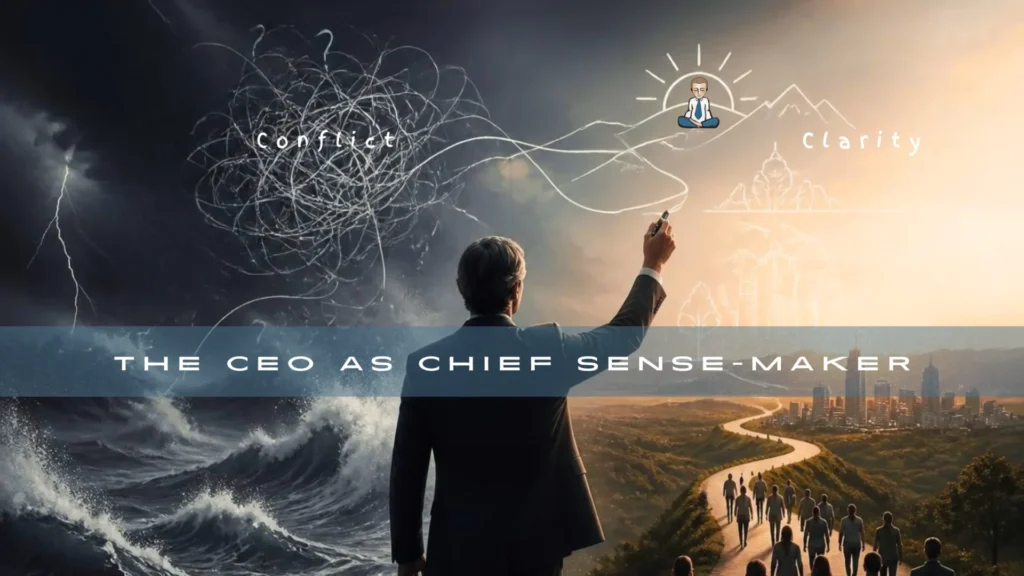
After 40 years moving between boardrooms and working with leaders, I have learned this: in moments of uncertainty, the CEO’s role is not to become the organization’s chief fortune-teller. It is to become its chief sense-maker.
Employees do not expect leaders to predict an unpredictable future. They need leaders to help them make sense of the present.
That distinction matters.
Information Is Not Clarity
During disruption, information arrives faster than wisdom.
As news channels and social media compete for urgency, any information vacuum is quickly filled by speculation and rumor. Every new development seems to demand an immediate conclusion.
The sense-making leader slows the cycle.
The task is not to comment on every headline but to distinguish what is significant from what is merely loud—and translate complexity into a shared understanding that helps people act.
A simple communication framework begins with four questions:
1. What do we know?
- Share verified facts without exaggeration.
2. What remains uncertain?
- Name the unknowns honestly rather than presenting assumptions as conclusions.
3. What are we doing now?
- Explain the immediate actions being taken to protect people, operations, and relationships.
4. When will we communicate again?
- Establish a dependable rhythm so employees are not left chasing updates.
These four questions replace speculation with orientation.
Interpret Events Through Three Lenses
At Corporate Sufi, I often speak about Business, Balance and Beyond. The same framework can guide leadership during a crisis.
Business: What could the disruption mean for customers, supply chains, costs, technology, and business continuity?
Balance: How is it affecting people emotionally, physically, and personally? Some may have family in conflict zones; others may be dealing with anxiety, financial pressure, or relentless exposure to distressing news.
Beyond: What do our values require of us? How will we act when commercial interests, human welfare, and moral responsibility collide?
Sense-making fails when it focuses only on the balance sheet. People need to know not only how the organization intends to perform but also what it stands for.
Offer Direction Without Manufacturing Certainty
Leaders sometimes fear that admitting uncertainty will weaken confidence. Often, the opposite is true.
People lose trust when leaders sound certain about what they cannot possibly know. Honest uncertainty, combined with clear action, is far more reassuring than false confidence.
A credible leader might say:
“We do not yet know how long this disruption will continue. Here is what we are monitoring, what would cause us to change course, and what we are doing to remain prepared.”
This is not indecision. It is disciplined humility.
Certainty says: “I know what will happen.”
Clarity says: “I understand what matters now, and this is how we will respond.”
Create Agency, Not Dependence
The purpose of sense-making is not to make everyone wait for top-down instructions. It is to give people enough context to exercise sound judgment themselves.
Tell managers which decisions they can make independently. Clarify the principles that should guide trade-offs. Invite insights from employees closest to customers, suppliers, and emerging risks.
In complexity, intelligence must travel both ways.
The CEO provides the bigger picture, but sense-making strengthens when the organization contributes what it sees on the ground.
Be the Emotional Weather—Without Denying the Storm
A leader’s emotional state travels through an organization faster than any memo.
Panic spreads. So does steadiness.
Steadiness does not mean pretending everything is fine. It means acknowledging the storm without becoming the storm.
Before addressing others, leaders need a moment of stillness themselves: pause, listen, separate personal fear from organizational fact, and then communicate with honesty, compassion, and proportion.
When the future is unclear, people do not need a leader who claims to see around every corner.
They need someone who can help them understand where they are, what they stand for, and the next wise step to take together.
That is the work of the CEO as chief sense-maker.