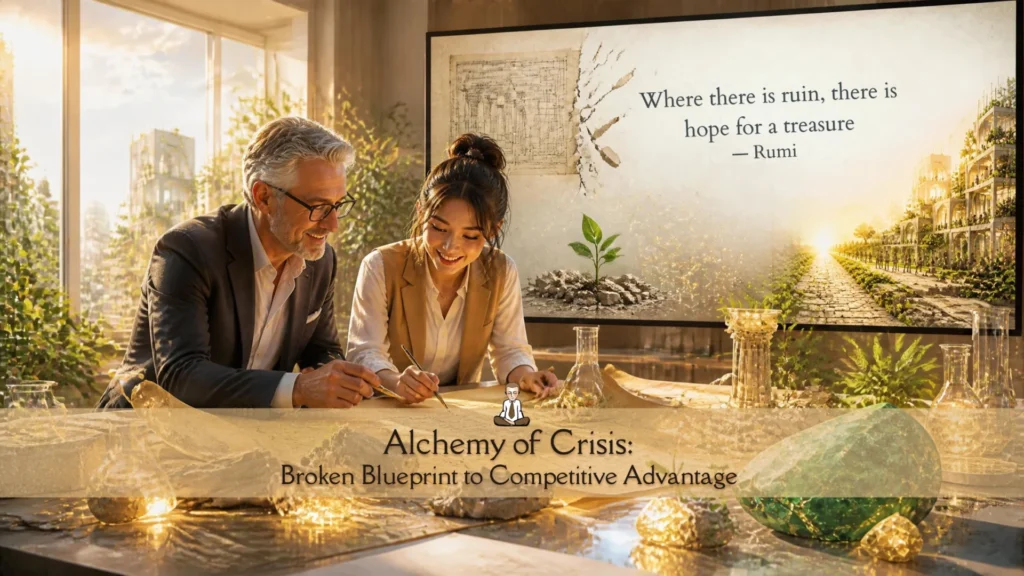
Every generation inherits its own challenges. For Gen Z, those challenges include economic uncertainty, rising costs, shrinking career pathways, and milestones such as homeownership that feel increasingly out of reach.
When speaking with young leaders, I often return to Rumi’s timeless wisdom:
“Where there is ruin, there is hope for a treasure.”
Much of what Gen Z faces can feel like ruin—war, climate emergencies, AI-driven disruption, and economic pressures that challenge traditional definitions of success.
A 2026 UK Youth Poll found that nearly two-thirds of 18–29-year-olds expect to be worse off than their parents. Deloitte’s 2025 global survey found that 48% of Gen Z respondents felt financially insecure, while 40% felt stressed or anxious all or most of the time.
Yet these challenges may also be catalysts. Many young people remain optimistic about their personal future, even while questioning the systems around them.
The question is: Are we supporting them through this disruption—or allowing overlapping crises to become a dead end?
The Corporate Sufi perspective offers another possibility: turn the crisis into a catalyst for growth, purpose, and significance.
Disruption Drives Development
Traditional leadership often measures success through linear KPIs: growth, loyalty, productivity, and material accumulation. Corporate Sufi leadership asks a deeper question: What is our success for?
The treasure within today’s economic “ruin” may be discovered by leaders who:
- Reject burnout as the price of success.
- Build organizations around sustainability, well-being, and authentic purpose.
- Recognize personal well-being as a collective responsibility.
- Measure impact not only by what is achieved, but by how it is achieved.
Takeaway: When institutions can no longer guarantee stability, leaders must look inward—to values, purpose, and significance—to redefine what meaningful success looks like.
Instability Inspires Innovation
When traditional career paths shrink, creativity expands. When old structures no longer work, new ones become possible.
For Gen Z, this may mean embracing entrepreneurship, the creator economy, portfolio careers, and AI as a collaborative tool rather than simply a threat to employment.
This is where the SPARK philosophy becomes particularly relevant:
Service — How can my work create value for others?
Purpose—What truly matters to me?
Attraction—How do I become a magnet for people and opportunities aligned with my values?
Resilience—How do I turn adversity into strength?
Knowing—What does my inner truth tell me?
Together, these qualities help emerging leaders navigate ambiguity without losing themselves.
Takeaway: The future belongs not simply to those who adapt to change, but to those who use change to create more authentic, sustainable, and meaningful ways of working.
From Competition to Community
The disruption extends beyond careers. Rising barriers to homeownership, financial independence, and traditional milestones are also changing how Gen Z thinks about community and collective support.
This creates an opportunity for organizations to rethink leadership itself.
The Corporate Sufi leader moves:
- From command-and-control to collaboration.
- From individual dominance to collective intelligence.
- From hierarchical management to facilitation.
- From competition alone to ecosystems of mutual support.
Young leaders don’t necessarily need another executive telling them what to do. They need leaders willing to listen, connect, facilitate, and create space for their potential.
Takeaway: When traditional milestones feel out of reach, community becomes an important source of resilience. Leaders can help by building workplaces where people feel supported, connected, and empowered to contribute.
Lead Through the Ruin
Gen Z should not be viewed as a defeated generation. They may instead be the alchemists of a changing era—turning uncertainty into resilience, disruption into innovation, and disappointment into a demand for something better.
For established leaders, the opportunity is not to force the next generation back into a broken blueprint. It is to listen to their skepticism. Their questions may be a form of rigorous auditing, exposing what no longer works and revealing what needs to change.
Ask:
What can their pain teach us to protect?
What can their disappointment teach us to build?
What kind of future are we helping them create?
Corporate Sufi leadership reminds us that the greatest treasures are rarely found on the surface. They require us to dig deeper—to discover purpose, serve others, build resilience, and listen to our inner knowing.
The blueprint may be in ruins.
But the treasure hunt has just begun.
And perhaps that is the real opportunity for Gen Z—and for all of us: not simply to rebuild the old blueprint, but to create a better one!