Screens on our walls. Screens on our desks. Screens in our hands. Screens on our laps. Screens strapped to our wrists. And now, screens are on our eyes too.
Has every surface of our lives become a screen?
Gen Z professionals have never known a world without screens—to learn, work, and unwind. Their lives are filled with notifications, chats, dashboards, and AI prompts. They are constantly connected.
But are they truly present?
The Cost of Constant Connectivity
While the financial cost of staying connected continues to fall, the cognitive and psychological costs are rising. This is particularly noticeable among Gen Z professionals. This is challenging leaders to address its impact more urgently.
Often called “digital fatigue” or “digital burnout,” this always-on culture is turning confident, digitally fluent young minds into anxious, distracted, and overwhelmed professionals early in their careers.
Before leaders can help, they must understand the underlying challenges.
Personal & Professional Predicaments
Three challenges are particularly evident in today’s workplace:
Attention Switching: A world of digital shortcuts has trained Gen Z to prioritize quick outcomes over foundational skills such as comprehension, focus, and memory. Attention becomes fragmented, encouraging greater dependence on chatbots and AI agents rather than independent thinking (D. Ambrosi).
Social Envy: Hyperconnectivity exposes young professionals to curated influencer lifestyles, leaving them feeling left behind. In trying to keep up, they underestimate the true cost of comparison and develop expectations they may never meet (NIH).
Relationship Erosion: Automated, digitally connected workplaces can weaken in-person relationships. Screen-led interactions often become transactional, making it harder to build meaningful connections and collaborate effectively (E. Shah).
These three challenges highlight the urgency of rebalancing our pursuit of success with a passion for significance.
Knowledge to Knowing
In last week’s blog, Soul Over Software: Purpose, Pathway, Partnership, we explored how preserving individual agency requires a shared mindset of significance.
But partnership with others begins with presence within ourselves. A mind pulled in multiple directions cannot listen fully, think clearly, or contribute meaningfully.
This week, I explore the Knowing principle within SPARK. Not knowledge, but knowing.
Knowledge is external, factual, and useful for developing skills and worldly efficiency. Knowing is an inner realization that draws on our innate intelligence, intuition, and instinct. Both matter, but they serve different purposes.
Think of knowledge as a pathway to success and knowing as a blueprint for significance.
For example, memorizing a sales presentation and scripting responses to client objections demonstrates knowledge. Sensing shifts in a client’s energy, understanding their deeper needs and responding authentically demonstrates knowing.
In short, the pursuit of knowledge is rooted in education; the pursuit of knowing is deepened through meditation.
Meditation, one of the three sub-elements of Knowing, is not simply about finding a quiet place. It is about cultivating the quality of our attention. By releasing conditioned thoughts and emotional clutter, we strengthen our inner awareness and reclaim ownership of our consciousness.
It helps us find peace amid chaos, develop self-awareness, focus our thoughts, and balance our emotions.
When we pause to recognize our impatience, worries, and distractions, we become better equipped to anticipate and navigate arguments, criticism, and challenges. We develop more authentic responses, guided by intrinsic motivation rather than external noise.
Inner Stillness and Shared Significance
Modern life has narrowed our experience of consciousness from a lantern-like awareness to a spotlight-like alertness. The economic, cultural and social structures in which Gen Z operates increasingly shape how they experience life, work, play and even pray.
With technology advancing rapidly and AI promising to optimize almost everything, there is an urgent need to restore a mindset of presence—one that honours the natural, rational, and resourceful qualities of being human.
How can leaders create professional pathways back to the inner stillness and shared significance that inspire us?
Here are three practical ways to introduce meditation initiatives:
These are not demands for mastery, but invitations for leaders to support healthier boundaries and protect their teams’ mental bandwidth.
1. Reconnect with Real
Introduce at least one “digital-detox” day or period each week, reducing automated workflows and prioritizing human connection for meaningful collaboration.
Think: Half-Day Away retreats where colleagues dream, design and reflect in silence, followed by face-to-face brainstorming, mentorship, and team-building.
2. Screen Safety Zones
Healthy relationships need boundaries. Establish workplace guardrails that protect both the psychological and physical well-being of teams. A simple commitment to disconnect after 6 p.m. can make a meaningful difference.
Think: Actual, Not Virtual experiences that encourage colleagues to attend in-person, mind-revitalizing events. Complement these with screen-free spaces where colleagues can reconnect and share experiences face-to-face.
3. Meditation Mode Meetings
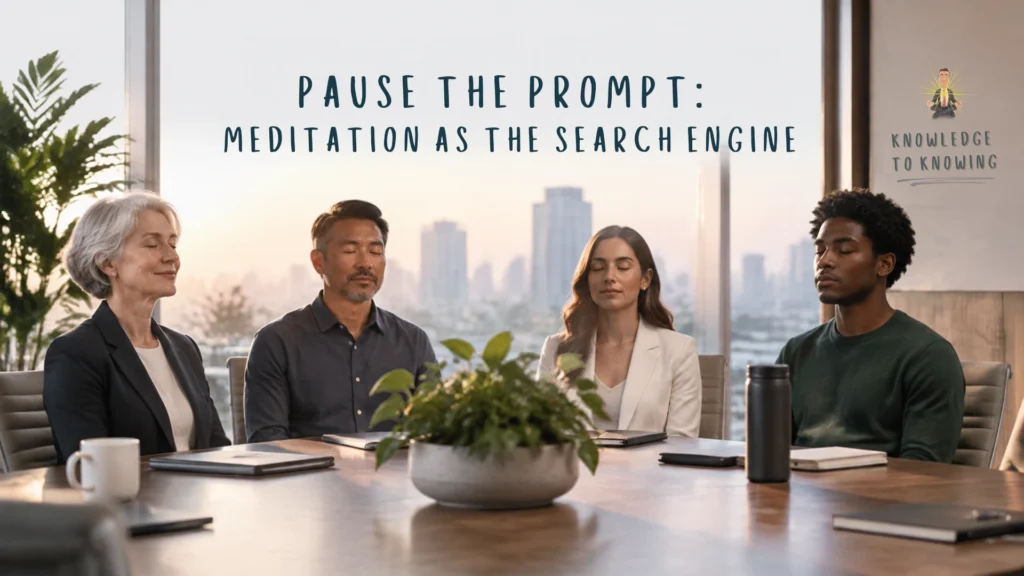
Leaders should not simply sponsor mindfulness; they should practice it. Open and close meetings with two to five minutes of shared stillness. Turn off, or remove, screens that create distance between people.
Think: Mindful Mondays, dedicated to individual and collective well-being. Introduce calendar-protected meditation breaks and opportunities for colleagues to help one another regain their focus and flow.
Such practices can transform organizational culture and consciousness.
SPARK Connection: Flow, Grow…Know!
To flow fluidly, be at your lightest. To grow organically, be authentic. To know wholly, be your true self.
Finding your true self comes not through technology, but through reconnecting with your humanity. Acknowledge, nurture and free it regularly. Being fully present is one of our greatest competitive advantages.
AI can process, package and promote information in seconds. But noticing a struggling colleague, sensing tension in a room or bringing genuine calm to a difficult situation are distinctly human gifts.
Meditation sharpens these gifts.
Leaders should encourage daily practice—not as a workplace perk, but as an investment in clearer thinking, healthier people and more effective organizations.
When you know your Self, you serve others better. Every mindful breath taken in silence brings you one step closer to that knowing.
Which of these initiatives SPARK your curiosity? How might you introduce a daily practice of stillness that helps your team think, connect and create more meaningfully?