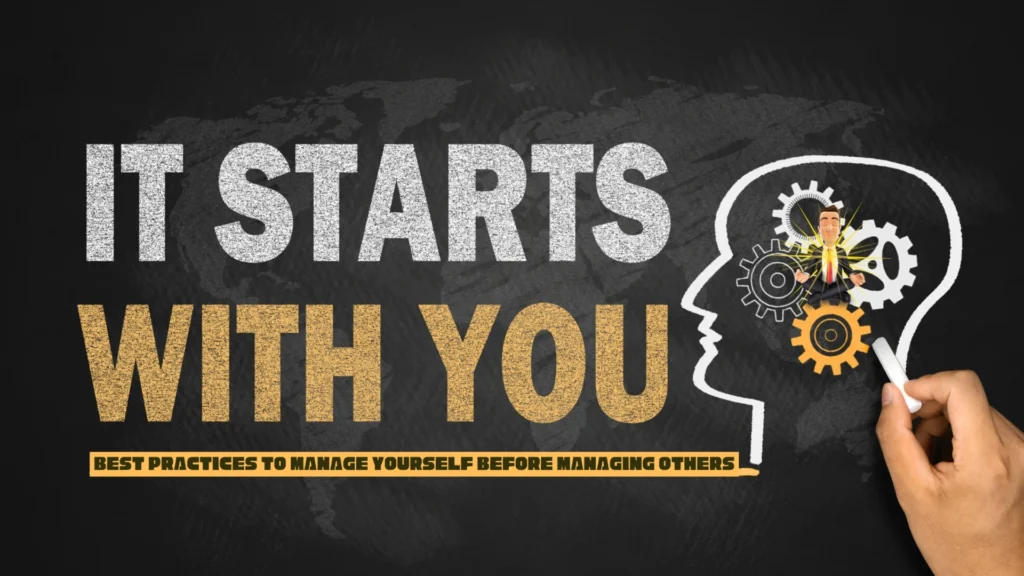
Most leadership manuals begin with how to influence others—motivate teams, manage performance, shape culture, and resolve conflict.
Yet after decades of coaching leaders across industries, one uncomfortable truth keeps emerging:
If you can’t manage yourself, you will eventually mismanage everyone else.
You may still hit targets and appear capable. But your team feels the gap—through inconsistency, reactivity, control, mixed signals, or fatigue disguised as urgency.
Leadership is not merely a skill set. It is a state.
Whatever state you operate from—clarity or chaos, calm or anxiety—spreads quickly.
Effective leadership therefore begins inside.
1. Manage Your State Before You Manage the Room
Every meeting has emotional weather—and leaders set the climate.
Walk in rushed or tense, and creativity shrinks while defensiveness rises. People shift from contribution to protection.
Best Practice –
Before important conversations, pause for 60 seconds and ask:
- What am I bringing into this room?
- What state do I want to transmit instead?
Then, regulate – breathe slowly, relax your jaw, slow your speech. Enter as if you have time.
Leaders who manage their state create psychological safety—and safety drives performance.
2. Align Actions With Purpose and Values
Much leadership exhaustion comes from inner contradiction—preaching balance while modelling burnout, or valuing respect while tolerating poor behaviour.
Alignment conserves energy. Misalignment creates friction.
Best Practice –
Make values visible:
- Identify your top three values.
- Translate each into observable behaviour.
Example:
- Respect → I listen without interrupting.
- Excellence → I give clear standards, not vague pressure.
- Wellbeing → I protect recovery, not overwork.
End each day with a simple integrity check:
- Did I live my values today?
- Where did I compromise them?
Small daily corrections prevent value drift.
When tough decisions arise, say it aloud: “If we truly value this, here’s what it looks like.”
Values become real when they cost something.
3. Manage Your Triggers
Many “people problems” are actually trigger problems.
- A missed deadline may activate fear of failure.
- A challenge may threaten identity.
- Silence may trigger loss of control.
Unchecked triggers lead to reactive leadership.
Best Practice –
When emotion rises, pause and remind yourself: This is a trigger, not a threat.
Then ask:
- What story am I telling myself?
- What else could be true?
That pause restores choice—and maturity.
4. Manage Your Presence
Leaders train teams through attention.
Best Practice –
- Focus on mistakes and people hide.
- Reward urgency and people panic.
- Arrive distracted and engagement disappears.
Practical shifts:
- Put the phone down in 1:1s. Attention signals respect.
- Replace urgency with clarity: “What matters most in the next 24 hours?”
- Normalize learning by asking weekly: What did we learn?
- Close conversations clearly: “What’s your next step, and what support do you need?”
Presence is instructional. Make yours steady and clear.
5. Manage Your Agreements
Self-management becomes visible in one question: Do you keep your word?
Leaders often demand accountability while modelling inconsistency—vague commitments, shifting priorities, delayed responses.
Teams don’t need more motivation. They need predictability.
Best Practice –
Adopt a simple rule:
- If yes → confirm it.
- If maybe → say maybe.
- If no → decline cleanly.
Trust grows when commitments are reliable—and performance follows.
6. Manage Your Ego
Ego-led leadership seeks to be right, impressive, or in control. But, ego creates distance. Distance creates silence. Silence creates failure.
Strong leaders remain available—to feedback, learning, and repair.
Best Practice –
Use these phrases more often:
- “I may be missing something.”
- “Tell me what you see.”
- “I was wrong—let’s correct it.”
Humility is not weakness. It is stability—and stability builds trust.
The Real Upgrade
The greatest gift you give your team is your own inner work.
Leadership then shifts from:
Control → Capacity
Pressure → Presence
Performance → TrustBefore asking, How do I manage my team better?
Ask instead: What part of me is unmanaged and shaping my leadership?
Because the first person you lead is always yourself!
6 Responses
Dear Azim,
This is a very helpful and timely article for me, I sincerely appreciated. It is clear with practice suggestions and reflective questions, which is very effective, thank you.
Dear Hamidah, thank you for your feedback. Glad it was of help..
This is so good. Lots of learning
Dear Hanifa, thank you for your feedback. Glad it was of help. Do share if any particular idea/s especially helped you resolve or manage a situation better at work. Do share if any particular idea/s especially helped you resolve or manage a situation better at work.
Dear Azim Sir.
Thank you so much for sharing this valuable knowledge; it really supports me in my daily activities as a manager in my professional life, so I am waiting for the next topics.
Dear Mahram, Thank you for your feedback. I am glad the content is of help. Do share if any particular idea especially helped resnated.