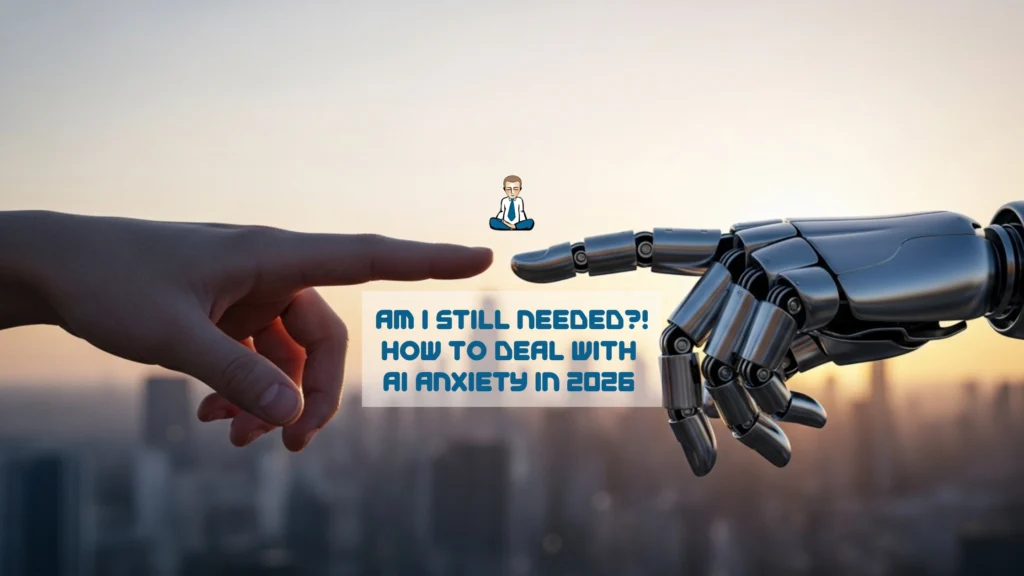
Work in 2026 looks familiar. Meetings continue. Dashboards refresh. Emails still arrive too late. Yet beneath the routine, something fundamental has shifted. A quiet question now hums through many workplaces:
“Am I still needed?”
This isn’t ordinary career anxiety. It’s existential. Because AI isn’t just changing what we do—it’s challenging who we believe we are at work.
For years, many built their identity around being “the person who can do X”—write, analyse, plan, design, negotiate, manage. Now machines can do much of that faster and cheaper.
So the deeper fear isn’t: “Will AI take my job?”
It’s: “If this can be automated, what am I worth?”
That’s why AI in 2026 is no longer just a tool conversation, it’s an identity observation, examination and calibration.
The Hidden Cost of Obsolescence Anxiety
When people feel replaceable, behaviour shifts—and not for the better.
As a result, you see:
- Overwork as self-defence
- Perfectionism to avoid mistakes
- Resistance disguised as “standards”
- Hyper-competition instead of collaboration
- Learning paralysis
- Quiet shame about using AI
Fear doesn’t make people adaptive, it makes them defensive, and defensiveness kills curiosity and learning.
Why This Feels So Personal
Past disruptions changed workflows. AI touches something deeper: the belief that our ability to think, feel and imagine was the safe part.
Many assumed, even if tools change, my intelligence is conclusively mine. But now, even that tool operates within an intelligence orb.
When any entity challenges your intelligence, it is normal for the ego to panic. As a human being you either cling to old identities or perform new ones. But it is important to understand that neither is real transformation—just different costumes.
Where Leadership Often Misses the Mark
Leaders respond with slogans:
- “AI won’t replace you—people who use AI will.”
- “We must all be AI-first.”
- “This is exciting!”
These aren’t wrong. They just clearly emotionally tone-deaf. Fear can’t be coached away with enthusiasm. What is needed instead is an environment of safety, clarity, and a credible path forward.
Three Leadership Shifts That Actually Help
1. Separate role risk from human value
Yes, tasks will change. Some roles will evolve. But be explicit:
- Tasks become obsolete. Humans don’t.
- The goal isn’t to protect old work—it’s to elevate human work.
Name what remains uniquely human: judgment, ethics, empathy, context, creativity, leadership, and making meaning matter.
2. Restore learning dignity
Most AI anxiety is really humiliation anxiety. People fear looking foolish while learning. Normalize beginnerhood:
- Create safe spaces to experiment
- Reward attempts, not just outcomes
- Let leaders say, “I’m learning too”
- Make “I don’t know” respectable again
When learning feels safe, fear loosens its grip.
3. Replace pressure with a pathway
“Adopt AI” is not a strategy. Instead, offer a simple ladder:
- Assist: drafting, summarising
- Accelerate: testing options faster
- Augment: improving judgment
- Architect: redesigning work for higher-value human contribution
Clarity reduces fear. Pathways create momentum.
What Employees Can Do Instead of Panicking
Don’t try to be AI-ready. Be reality-ready. AI runs on data and logic. Humans run on meaning and purpose.
Start small:
- Use AI in one workflow to reduce friction
- Reinvest saved time into relationships, strategy, and deep thinking
- Build a “human moat”: judgment, empathy, ethics, leadership
- Learn in public, a little
- Use AI to challenge assumptions, not replace reflection
AI accelerates activity. Only humans decide if the activity matters. You don’t need to outrun the machine. You need to outgrow your outdated self-image.
The Real Invitation for 2026
AI is exposing a fragile idea—that our worth is tied to a narrow skill set. If your identity is: “I matter because I can do this task,” you will live in fear. If it becomes: “I matter because I can learn, discern, adapt, and serve,” you remain free. The real question of 2026 isn’t: “How do I protect my relevance?”, it’s: “How do I deepen my contribution?”
Relevance keeps you in the room. Contribution makes your presence meaningful. Let AI accelerate your tasks. Let experience sharpen your judgment. Let purpose guide your work. Because long after today’s tools are obsolete, the SPARK of humanity still matters.