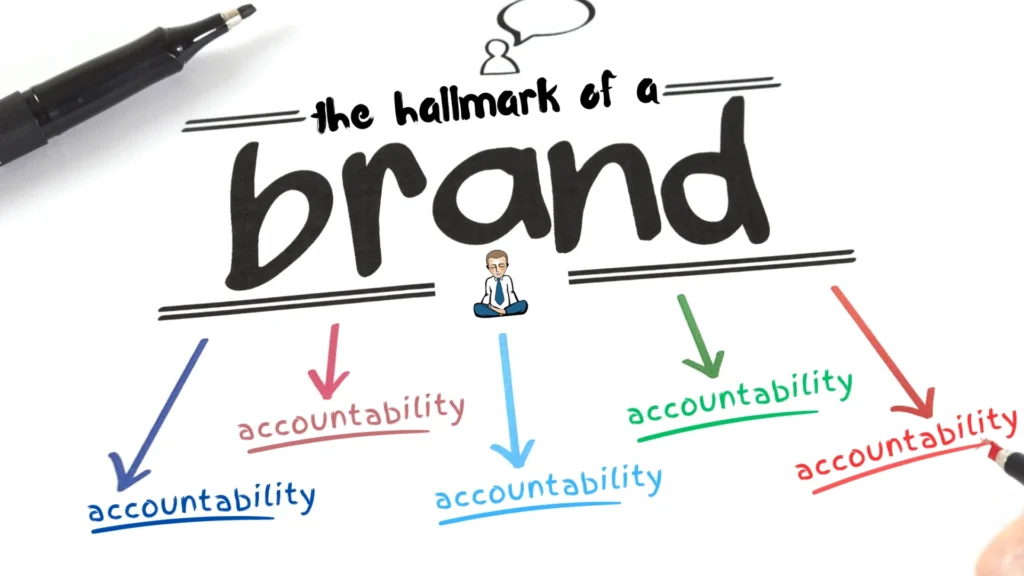
Leaders often equate having a strong brand with the consumer’s ability to identify marks, methods, and meaning. But how many stop to ask a simple question:
“Do people genuinely trust us when something goes sideways?”
When working with leaders to whom I pose this question, I often face hesitation. In that pause is usually where the real truth lies.
Organizations still view a brand as visibility—the logo, campaigns, website, social media presence, events, and the story they tell the world. These things matter. But they do not fully express the brand at its deepest level.
Your brand should go beyond the performative marketing people remember when things are going well. More importantly, your brand must act as a demonstrative movement that is consistently aligned to your promise. A pledge people fully believe you can, and will, live up to when things go wrong.
They’re not looking for perfection, but honesty, responsibility, and transparency.
This is where making accountability a hallmark of your brand strategy can be the difference. Embedding radical transparency, measurable commitments, and responsive communication into your core operations can turn a fleeting brand mark into an enduring trademark that lives on in the consumer consciousness.
Every brand eventually faces moments when promises are tested. In those moments, the question is not, “What does the brochure say?”, but “How does the organization behave?”.
Accountability feels human when:
- It admits a mistake and acts quickly to build trust rather than pretend nothing happened.
- It sees the problem; accepts its role, and makes things right by strengthening that trust.
Customers are tired of polished promises and are looking for accountability as proof of character. Finding it consistently builds loyalty in a way that no campaign can manufacture.
Accountability Turns Claims into Credibility
Almost every brand claims to care.
But care is not proven through claims. It is proven through consequences.
Accountability is the difference between brand language and brand behaviour.
Language may attract attention, but behaviour earns belief.
Accountability Starts at the Top
There is no organizational accountability without leadership accountability. When leaders model accountability they are a catalyst for the entire organization to do the same. They replace a culture of self-protection with a culture of collective ownership.
Top executives flip the question from whether the organization has an accountability problem to where is accountability breaking down, and what am I doing to contribute to that?
How to Structurally SPARK Accountability into Your Brand
Accountability is not merely a value you declare. It is a system you design. Here is where to begin:
1. Measure Service Levels to Enhance Your Claim for Value.
If your organization says it values employee well-being, customer satisfaction, or environmental responsibility, those service commitments must be tracked, reported, and reviewed with the same rigour as financial performance.
What is not measured is not managed — and what is not managed is not credible.
2. Create Purpose Driven Structures for Honest Feedback.
Accountability requires information, and information requires psychological safety. Leaders must build purpose-driven channels through which difficult truths can travel upward without cost to the messenger.
The organization that only hears good news is not well-led. It is insulated.
3. Closing Public Loops Attract Lasting Confidence.
When commitments are made — to customers, employees, and the market—follow up visibly. Acknowledge what was achieved and what was not. Explain what changed and why.
This is not a weakness. It is the behaviour that attracts lasting confidence.
4. Separate Accountability from Blame to Build Brand Resilience.
A culture of blame drives problems underground. A culture of accountability brings them into the open, where they can be solved. The distinction matters enormously. Blame asks who is responsible in order to punish. Accountability asks what happened in order to improve.
Brand resilience is built on an open commitment to a common transparency.
5. Set Accountability Standards by Knowing Your Stakeholders.
Meaningful accountability standards require a deep understanding of your specific stakeholders—who they are, what they need, and their level of influence. Tailoring goals, metrics, and communications to different stakeholder groups ensures expectations are realistic, transparent, and mutually beneficial.
Authentic Accountability Standards SPARK Significance
I have spent many decades working alongside leaders across industries and geographies. The ones who build organizations that truly endure share a common quality. They’re leaders who take full ownership for setting standards that help organizations value personal integrity, systemic transparency, and employee empowerment.
Accountability, at its deepest level, is not a brand strategy at all. It is an expression of the connection between the leader’s and organization’s core traits — of the alignment between inner values and outer conduct that is the foundation of a genuine partnership. When that alignment is present, the brand takes care of itself. When it is absent, no strategy compensates for the gap.
Visionary leaders refuse to use accountability as a tool for managing perception but rather as a practice for building something real.
In a world hungry for authenticity and consistency, leaders who move their core value from success to significance build the most powerful brand position of all.